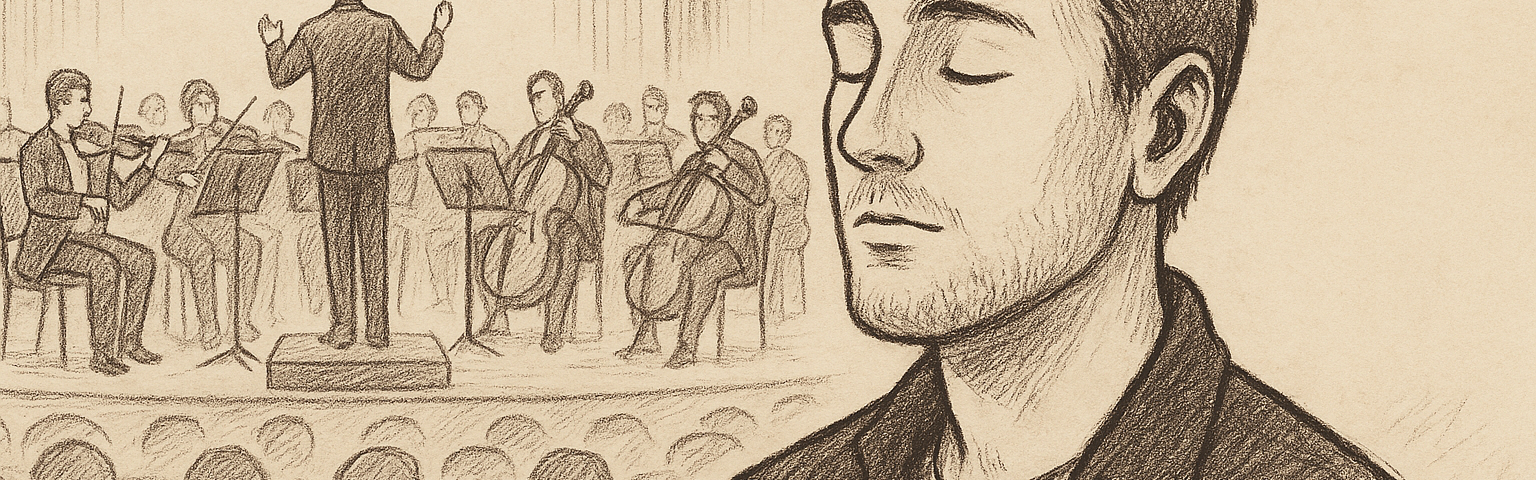
When conversations turn to “classical” music, people often say, “I don’t know anything about music.” What they usually mean is that they haven’t studied theory, can’t read a score, or don’t know the names of composers. But this confuses knowledge about music with the experience of music. The truth is, you don’t need to “know” anything in order to listen. Music speaks directly to the human being without needing translation.
The Universality of Emotion in Music
The most immediate way music speaks is through emotion. In this sense, music is universal: everyone recognises a happy song as happy, a sad song as sad. We may differ on the subtleties, but no one confuses a lively jig with a funeral march. This universal response underlies why music accompanies every culture’s rituals, celebrations, and laments.
Yet emotional response is not only universal; it is also personal. A funeral march will strike one listener more deeply than another depending on their own confrontation with grief. A love song is richer to someone who has loved and lost. The degree to which we experience the emotion in music is proportional to our own lived encounter with that emotion.
This is what David Whitwell observed so often: that music’s power is rooted in the honesty of its emotion, and in the listener’s capacity to connect that emotion to life.
The Development of Taste
At the same time, as we argued in relation to conductors, taste is not innate. Richard Payne Knight, David Hume, and other thinkers were clear: taste is cultivated through education and habit. While anyone can feel music immediately, repeated exposure refines our capacity to perceive more deeply.
A child delights in a simple nursery song; an adult returns to Bach or Beethoven and finds ever-deepening pleasure. The same listener, over years of hearing and reflecting, may move from enjoying simple melodies to finding joy in complex symphonic forms. This is not because they learn “facts about music,” but because their perception itself becomes more cultivated.
Taste, then, is not the opposite of emotion. It is the expansion of our ability to feel. By training perception, we increase the number of ways music can move us.
Two Journeys Intertwined
For the listener, then, there are two journeys at play:
- The Emotional-Experiential Journey
- The Cultivated Taste Journey
Neither journey is superior; both enrich one another. The emotionally alive listener who also cultivates taste finds that more and more music speaks to them with clarity and power.
A Practical Illustration
Consider Beethoven’s Eroica Symphony, with its monumental funeral march.
- To a listener who has suffered loss, the march immediately resonates. The tread of the basses and the crushing harmonies mirror their own grief. Even without knowing anything about symphonic form, they are moved.
- To a listener who has heard much music, studied Beethoven’s world, and cultivated taste, the same funeral march becomes doubly rich. They recognise its historical daring, its scale, its echoes of Gossec, and its place in the history of the genre. Their cultivated perception adds layers of pleasure to the raw emotional recognition.
Both responses are valid. One is immediate and experiential; the other is cultivated and informed. The deepest listening combines them.
The Listener’s Freedom
This double framework frees the listener from anxiety. You do not need to apologise for “not knowing about music.” Your feelings are already enough; music has always been for you. At the same time, you need not remain at the level of the immediate. By listening more, by revisiting works, by opening yourself to complexity, you cultivate taste — and in doing so, you give yourself more ways to be moved.
The listener’s journey is therefore not about acquiring technical jargon, but about expanding perception. It is about becoming capable of hearing more, not to impress others, but to feel more deeply yourself.
Conclusion
The experience of music is at once universal and personal. It is universal in that joy, sadness, and awe are recognised by all. It is personal in that the depth of our response depends on the depth of our own life. And just as conductors must unite cultivated taste with emotional honesty, so too must listeners.
For the listener, the task is simple but profound: bring your life honestly to the music, and let the music speak honestly to your life. At the same time, cultivate your taste by listening more widely and deeply. Taste without emotion is sterile; emotion without taste is naïve. Together, they make music not just heard, but lived.