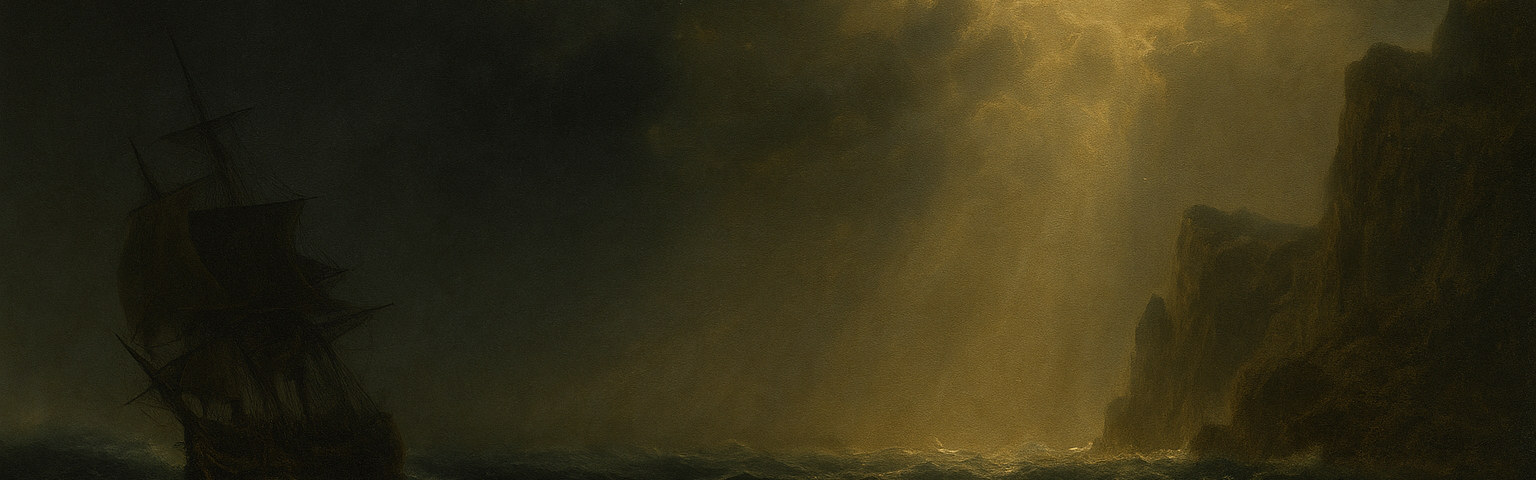
When François-Joseph Gossec unveiled his Marche lugubre in 1790, written for the memorial of the Nancy Affair, he did something unprecedented. He transformed a functional piece of ceremonial music, funeral marches, into an aesthetic experience so overwhelming that it echoed the philosophical categories of the day. Contemporaries described the work as having “lacerating harmonies” that “spread a religious terror in the soul.” Its fragmented phrases, sudden silences, and the thunderous tolling of the gong — the first time that instrument had been used in French band music — brought audiences into direct confrontation with what Edmund Burke had only recently defined as the sublime.
Edmund Burke and the Sublime
In his Philosophical Enquiry into the Origin of Our Ideas of the Sublime and Beautiful (1757), Burke distinguished between the beautiful and the sublime. Beauty, for him, was tied to harmony, proportion, smoothness, and delicacy — qualities that soothed and charmed. The sublime, by contrast, emerged from vastness, obscurity, darkness, terror, and power. It was not gentle but overwhelming; not pleasing but awe-inspiring.
Importantly, the sublime was not terror itself, but terror at a distance — the feeling of standing before a stormy mountain, a chasm, or a raging sea without being destroyed by it. The sublime humbled the individual, producing astonishment that, paradoxically, elevated the soul.
Burke himself rarely applied this framework to music, preferring examples from painting, architecture, and nature. Yet the aesthetic vocabulary he created seems tailor-made for describing the effect of Gossec’s Marche lugubre and the many funeral marches that followed.
Kant and the Musical Sublime
Immanuel Kant, who built on Burke’s theory in his Critique of Judgment (1790), was even less willing to admit music into the realm of the sublime. Kant often considered music the least rational of the arts, ephemeral and lacking the conceptual depth of poetry or painting. Yet his descriptions of the sublime — that which is boundless, threatening, or beyond the capacity of the imagination to fully grasp — resonate strongly with the qualities that composers of funeral marches sought to evoke.
Think of Beethoven’s Eroica funeral march, with its immense scale and inexorable tread; or Chopin’s Marche funèbre, which juxtaposes stark minor-key solemnity with a transcendent trio section. These works, though Kant never acknowledged them directly, enact the very movement from terror to transcendence that he described.
Gossec’s Innovation
What made Gossec’s Marche lugubre revolutionary was precisely this turn from function to feeling. Funeral marches had existed before, but Gossec injected an emotional violence that aligned perfectly with Burke’s categories. The work does not console; it overwhelms. The gong resounds like a cosmic toll. Silences hang like yawning abysses. The harmonies are crushing rather than sweet.
In short, the piece seizes the listener, placing them in an aesthetic experience that both terrifies and uplifts — the very definition of the sublime. Later composers recognised the power of this model, whether consciously or not, and the funeral march became a privileged genre for exploring the sublime in sound.
Catharsis and the Classical Tradition
Long before Burke or Kant, Plato had described the power of music and drama to purge the emotions through catharsis. For Plato, and later Aristotle, tragedy was valuable because it led audiences through fear and pity to a cleansing of the soul. In this sense, Gossec’s march and its descendants continue an ancient tradition.
The funeral march, like tragedy, does not avoid pain but channels it. It confronts us with loss, mortality, and dread — emotions that are overwhelming in themselves — and in doing so, purges and transforms them. Listeners leave not comforted in the shallow sense, but renewed, elevated, even ennobled. Burke’s sublime and Plato’s catharsis meet here in a striking synthesis: both theories recognise that profound art unsettles in order to heal.
The Funeral March as a Sublime Genre
From Gossec’s Paris to Beethoven’s Vienna to Chopin’s Paris salons, the funeral march became the most consistently sublime of musical genres. Its characteristics — slow tempo, heavy tread, dark harmonies, abrupt contrasts, immense scale — align almost perfectly with Burke’s description of the sublime.
But more than that, the funeral march became a public ritual of catharsis. Whether commemorating a fallen hero, a national tragedy, or a personal grief, it offered a communal space where the terror of death could be confronted and transformed into awe.
In an age when visual and literary theorists often doubted the philosophical seriousness of music, the funeral march quietly demonstrated that sound could achieve what mountains and storms did for Burke: it could overwhelm, terrify, and elevate all at once.
Conclusion
Gossec’s Marche lugubre is more than a historical curiosity. It is the first clear example of music consciously striving for the sublime — a piece that matches philosophical theory with aesthetic practice. Every funeral march that followed, from Cherubini to Beethoven to Chopin, stands in this lineage.
In them, we hear not only mourning but magnitude; not only sadness but sublimity. They remind us that music, at its most powerful, does not comfort by avoiding terror, but by leading us through it — from fear, to catharsis, to the awe that Burke called the sublime.