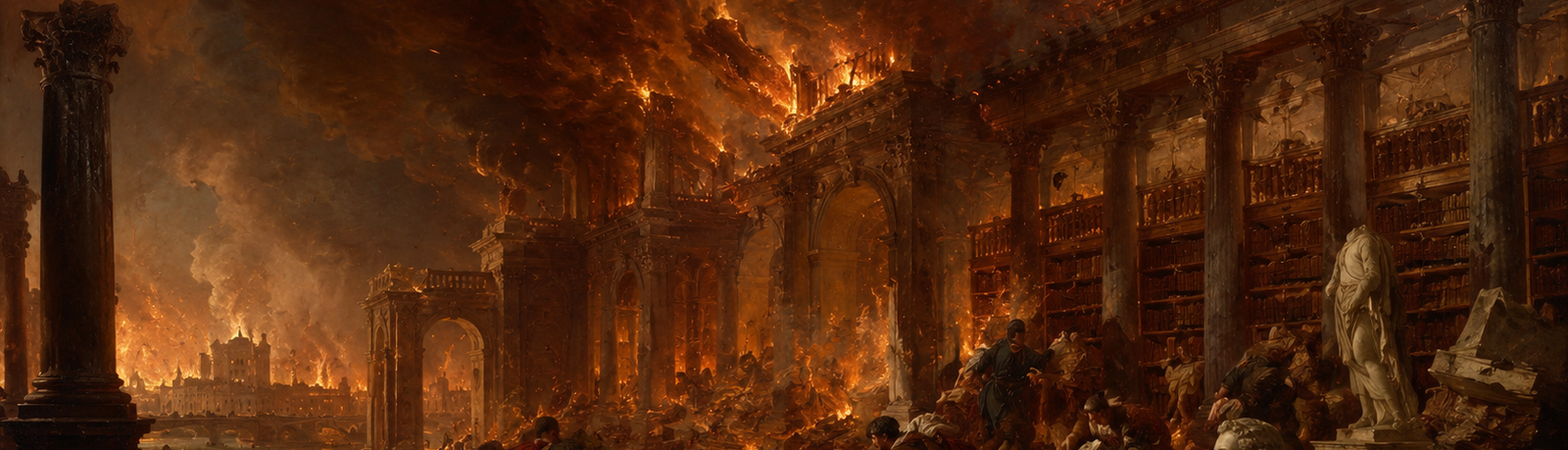
There is a tendency among musicians and historians to speak about the canon of classical music as though it were inevitable. Beethoven’s symphonies survive because they are masterpieces. Shostakovich’s Leningrad Symphony became famous because of its artistic and political significance. Important music rises naturally to the surface; unimportant music sinks. Music history, in this telling, is orderly and rational.
But every so often one encounters a story that reveals how terrifyingly fragile our musical inheritance really is.
Consider first the story of Dmitri Shostakovich’s Symphony No. 7 (Leningrad). During the siege of Leningrad in the Second World War, the symphony became a symbol of Soviet resistance. The score itself was photographed onto microfilm and secretly transported out of the Soviet Union through wartime channels, eventually reaching London and America. Had a plane crashed, had a diplomatic courier disappeared, had a single reel of film been damaged or confiscated, one of the most famous symphonies of the twentieth century might have remained unknown to the West for years — perhaps forever in its original wartime context. The mythology of the work today depends not only on Shostakovich’s genius, but on a chain of human survival, military logistics, propaganda strategy, and sheer luck.
Then there is the extraordinary story of Ludwig van Beethoven’s Symphony No. 7 arranged for Harmoniemusik. Beethoven’s publisher, Steiner, routinely advertised works in multiple formats before those arrangements even existed. If someone wanted a piano duet version or a wind arrangement, one would simply be made on demand. Scholars long assumed the advertised Harmoniemusik arrangement of the Seventh Symphony was merely one more fictional advertisement. No surviving parts had ever been found.
And then fate intervened.
An amateur Dutch horn player and musicologist, Willem Middelhoven, happened to notice a tiny newspaper reference mentioning a performance of an original wind version of the symphony in Essen. Not in a major catalogue. Not in a scholarly archive. In an old newspaper. His search led nowhere until a janitor overheard a conversation while sweeping a floor. That janitor remembered a deceased conductor. The conductor had a son. The son had inherited nothing — because the family had thrown the entire music library away after the father’s death. Everything was lost except for one set of parts kept merely as a souvenir.
One set.
Had the janitor taken a different lunch break that day, had Middelhoven arrived an hour earlier, had the family been slightly less sentimental, or slightly more tidy, the only surviving Harmoniemusik version of Beethoven’s Seventh Symphony might have vanished into a rubbish bin forever.
These stories should profoundly humble anyone who speaks confidently about “the repertoire.” We like to imagine that the masterpieces survived because civilisation carefully protected them. Often it did not. Often music survived because of accidents, coincidences, forgotten cupboards, badly organised libraries, widows reluctant to throw things away, or bureaucrats who happened not to notice what they were handling.
The twentieth century especially should cure us forever of the illusion that culture is permanent.
During World War II, entire archives disappeared overnight. Publishing houses were bombed. Church libraries burned. Theatre collections vanished. Private music libraries were abandoned during evacuations and never recovered. In many cases, we do not even know precisely what was lost because catalogues themselves were destroyed.
The bombing of Dresden alone obliterated enormous quantities of cultural material. Dresden had been one of Europe’s great musical centres for centuries. Manuscripts, performing materials, administrative records, and historical collections vanished in the firestorms. Similar losses occurred across Germany, Poland, Russia, France, and elsewhere. Countless local band and orchestra archives, collections, and unpublished manuscripts simply ceased to exist.
Nor is this merely a tragedy of the distant past. During the wars in Iraq, librarians, museum staff, archivists, and ordinary citizens reportedly risked their lives attempting to protect manuscripts, artworks, and historical artefacts from bombing, looting, and fire. Some smuggled materials out secretly; others hid collections in basements or private homes. The destruction and looting of institutions such as the National Museum of Iraq and the damage to libraries and archives became a stark reminder that civilisation is never as secure as it imagines itself to be. Much was saved through acts of courage. Much was lost forever.
And unlike famous paintings or celebrated monuments, much lost music leaves no visible absence. If a cathedral collapses, the world notices. If a manuscript disappears before it was catalogued, history may never realise it existed at all.
One suspects there are entire branches of music history that vanished simply because one manuscript was placed too close to a fire, one archivist retired, one publisher went bankrupt, or one family cleaned out an attic. We speak reverently of the “great works” of the nineteenth century without fully grasping how many equally valuable works may have disappeared through nothing more dramatic than bad timing.
Indeed, the very shape of musical taste may be partly accidental. If Mendelssohn had not revived Johann Sebastian Bach, would Bach occupy the same place in modern consciousness? If Mahler’s manuscripts had been destroyed during the Nazi era, would he today be central to orchestral life? If the microfilm carrying Shostakovich’s Seventh had been lost, would the symphony have acquired its legendary wartime aura?
Perhaps the canon is not simply a monument to greatness. Perhaps it is also a monument to survival.
For historians, conductors, performers, and archivists, this should create a sense not merely of scholarship, but of stewardship. Every neglected archive, every box of parts in a garage, every fading local band library may contain not merely curiosities, but alternate histories of music waiting to be rediscovered.
The distance between immortality and oblivion is sometimes nothing more than a janitor overhearing the right conversation — or a library surviving one more night.
And this, ultimately, is why I do what I do.
I am often asked why I bother. Why I spend my free time unearthing old music, typing in faded notes one by one, creating recordings, translating forgotten nineteenth-century books, and chasing down obscure references that almost no one else seems to care about.
This is why.
Because without this work, things disappear.
Not metaphorically. Literally.
Music vanishes. Ideas vanish. Entire traditions vanish. The history of band music — much of it survives today only because somewhere, at some point, somebody cared enough to preserve it before it was too late.
Sometimes history survives because of genius. But sometimes it survives because one person decided not to throw away a box of old parts. Or because someone took the time to copy a manuscript. Or because somebody believed that forgotten things still mattered.
I suppose, in my own small way, I am simply trying to be one more link in the chain of music history, before another library burns.
Craig Dabelstein. “Before Another Library Burns: how luck shapes music history.” craigdabelstein.com, 7 May 2026, https://craigdabelstein.com/before-another-library-burns-luck-music-history/.