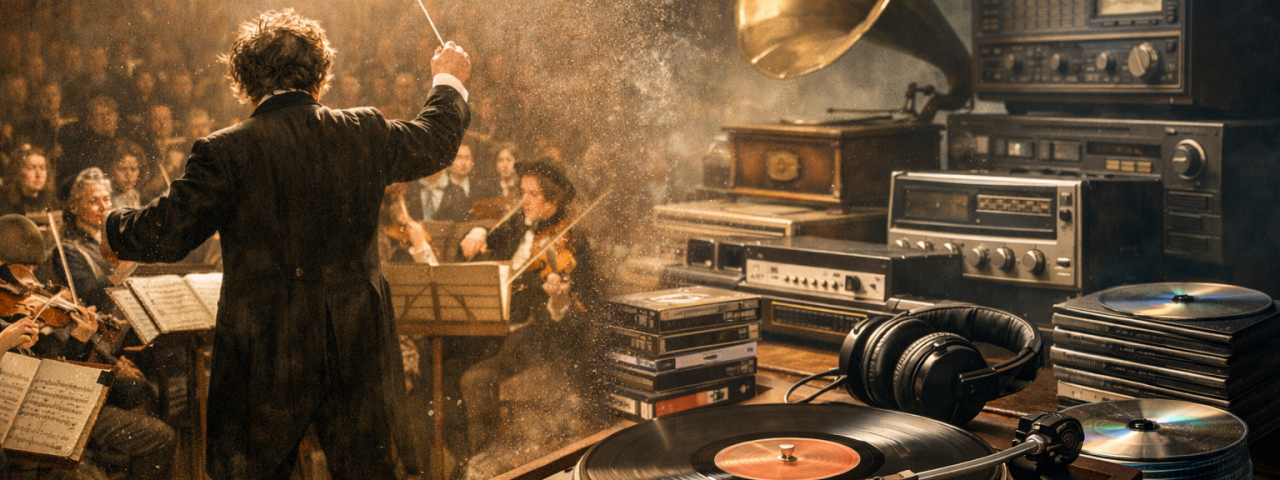
Imagine being present at the first performance of Beethoven’s Symphony No. 5 in Vienna in 1808.
The hall is cold. The programme is punishingly long. The orchestra is under-rehearsed. Beethoven is conducting. The concert lasts more than four hours. Somewhere in the middle of it all, those four notes are heard for the first time — not as an icon, not as a cultural cliché, but as something raw, insistent, and unsettling.
You leave the hall knowing that you have experienced something important, even if you cannot yet explain why.
The next morning, the thought comes naturally: I would love to hear that again.
But there is no way to do so.
There is no recording. No radio broadcast. No catalogue to browse. The phonograph will not exist for another seventy years. Commercial gramophone records will not become available until the 1890s, and even then they will be expensive, limited in repertoire, and incapable of reproducing large-scale orchestral sound. Radio broadcasting to the general public will not arrive until the early 1920s. And it will not be until 1925, with the introduction of electrical recording, that sound reproduction begins to approximate orchestral balance in any meaningful way.
For now, the music is already gone.
For most of human history — and certainly from 1800 to 1925 — this was the normal condition of musical life. Music existed almost entirely as a live event. When the concert was finished, it vanished completely. What remained was memory: fragments of sound, emotional afterimages, a sense of having been altered by something fleeting.
In the days and weeks that follow, Beethoven’s symphony lives on internally. Not bar by bar, but as remembered force: the opening hammer-blow, the relentlessness, the sense of being pushed forward through resistance, the triumphant finale. The details blur quickly. A week later, you may not even remember the tune. But what survives is what mattered. The music becomes something imagined rather than repeated, something felt rather than checked. You remember the feeling.
And the waiting matters.
Months pass. Perhaps years. The desire to hear the symphony again does not fade; it intensifies. There is no saturation, no background listening, no slow erosion through familiarity. When the work finally reappears — perhaps in another city, under another conductor — the experience is not casual. This is not “another performance.” It is exciting. It is a return.
Now imagine something even more charged.
Five years later, that same listener is sitting in their orchestra rehearsal. They open their part and see the title: Beethoven — Symphony No. 5. Tonight, they will not merely hear the work again. They will help bring it into existence.
This is not routine. It is not just another performance of Beethoven.
They practise with urgency — not simply to master the notes, but to reconnect with a feeling that has lived inside them for years. There is no definitive recording to imitate, no accepted tempo to consult. What guides them is memory: how the music once felt in the hall, how it seemed to grip the audience, how it lodged itself in the body.
Imagine their disappointment when rehearsal does not rekindle that same feeling. How much harder do they practise? How much more intensely do they listen? How much do they discuss problems between section leaders? How much extra time and effort do they invest in the hope of recreating that initial experience?
Technique matters — but it is not the goal. The goal is recognition.
This way of encountering music did not vanish with Beethoven. It remained the norm well into the late nineteenth and early twentieth centuries.
Imagine hearing Gustav Mahler’s Symphony No. 5 for the first time in 1904. There is still no radio. Recordings exist only as short, acoustically captured discs made through large recording horns. These early records cannot reproduce the scale, dynamic range, colour, or spatial impact of a live symphony orchestra in any meaningful way. A work like Mahler’s Fifth is effectively unrecordable. It will be another twenty years, until electrical recording is introduced in 1925, before orchestral sound can even begin to be captured with convincing balance — and several more decades before recordings offer a richness that might satisfy a listener accustomed to live performance.
For Mahler’s contemporaries, the symphony is still experienced almost entirely as an event: overwhelming, baffling, intensely human, and impossible to revisit at will.
If the music affects them, it does so without mediation. And if, years later, they perform it themselves, they are not reproducing a familiar object. They are trying to give form to an experience that once shook them.
This order matters.
Modern musicians often begin by playing a piece and only later try to feel it. Musicians formed during the age of live musical experience — roughly 1800 to 1925 — often began by feeling a piece and only later had the opportunity to play it. Emotion preceded execution. Memory preceded repetition.
In such a world, performance carried a different weight. A concert might be the only chance to encounter a work for years, or even for a lifetime. Rehearsals were preparation for a singular event, not for endless cycles of replay. The performance was not disposable. It mattered — because it might not happen again.
Aesthetic judgement developed under these conditions as well. Imagine people discussing the Beethoven concert a week later. The conversation might have sounded something like this:
“How good was that Beethoven concert last week?”
“It was amazing. So dramatic. And that finale — wow.”
“The finale? What about the opening? It scared me at first, but I’ve been humming it all week.”
In my imagination, the conversation is brimming with excitement, filled with descriptions of how the music made them feel.
Music was judged by what it did in the room. Did it hold attention? Did it move people? Did it justify its existence? It was emotional impact that generated enthusiasm for another performance, and then another, and then another, until the work we now call Beethoven’s Fifth became known across the world.
It is also difficult, from a modern perspective, to imagine just how infrequently most people encountered live music. Even in major European cities, going to a concert was not a nightly or even weekly habit for the majority of listeners. For many, hearing a symphony orchestra might happen only a few times a year — perhaps once a month, or even less. Outside large urban centres, opportunities were rarer still. Music did not fill the background of daily life; it punctuated it.
Each concert therefore carried disproportionate weight. When people did attend, they were not comparing the performance with a remembered recording, but with the emotional residue of previous concerts — sometimes months or years apart. Musical judgement was formed by contrasting one lived experience with another: this night felt more urgent than the last; this performance moved me differently; this work stayed with me longer. Taste was shaped not through saturation, but through the accumulation of memory.
This musical ecology dominated for more than a century. After 1925, a fundamentally different world begins to emerge — one in which sound becomes repeatable, portable, and increasingly authoritative.
Now imagine a different scene.
A young trumpeter today has just been accepted into a local youth orchestra. Rehearsal schedules arrive by email. The repertoire list is exciting: Ludwig van Beethoven — Symphony No. 5.
Are they excited? Of course they are.
This is a great piece. A famous piece. A rite of passage. Friends congratulate them. Teachers nod approvingly. There is a sense of occasion.
But this young trumpeter has already heard the symphony many times.
They have heard it on streaming services, in films, on television, in advertisements. They have heard it in the car, through headphones, in the background while doing homework. They may have studied excerpts at school, listened to multiple recordings, watched performances online. The opening four notes are already familiar long before the first rehearsal.
When they open the part for the first time, there is anticipation — but not mystery.
They are not waiting to discover what the piece is like. They already know. They know how it goes. They know how it ends. They may even have strong opinions about tempo, balance, or style, shaped by recordings they admire. Their task is not to meet the work for the first time, but to re-enter something already known.
This does not make their experience invalid. But it does make it different.
The excitement is real, but it is moderated. There is less shock, less risk, less sense of stepping into the unknown. The work does not arrive as an unanswered question. It arrives with a long history already attached to it — and with familiarity comes a subtle flattening of intensity.
My theory is a simple one.
Our constant access to recordings has quietly reduced the peak of our aesthetic response. Not because we care less, but because we arrive already informed. Already saturated. Already prepared.
We still enjoy great music. We still value it. We still play it with commitment. But we rarely encounter it under conditions of true scarcity. We almost never wait years to hear a work again. We almost never carry it in memory alone. We almost never practise in the hope of rediscovering a feeling rather than matching a sound.
The young trumpeter today may play Beethoven’s Fifth superbly — technically, stylistically, even passionately. But the emotional charge surrounding that first encounter is inevitably different from that of a musician in the age of live musical experience.
Not because modern musicians are inferior — but because the conditions that once intensified desire, anticipation, and wonder no longer exist.
When music can always be heard, it no longer has to be longed for.
And something in our aesthetic response quietly adjusts itself downward.