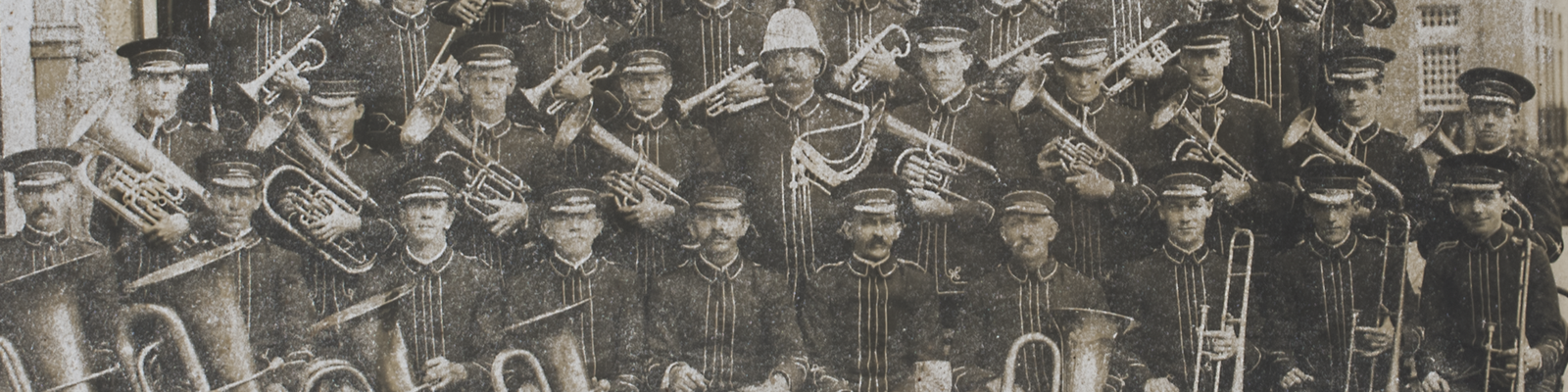
By the end of the nineteenth century, the hierarchy of Western musical life appeared firmly established. The symphony orchestra stood as the pre-eminent vehicle of “serious” art, consecrated by conservatoires, critics, publishers, and concert institutions. The wind band, by contrast, were regarded as utilitarian, popular, or educational — valuable perhaps, but rarely artistic in the highest sense.
Yet this outcome was far from inevitable. Throughout the nineteenth century, military bands were the subject of intense artistic ambition, repeated reform, and sustained public enthusiasm. To understand why the orchestra achieved cultural stability while the band did not, one must look not at taste alone, but at structural instability.
1. Instrumentation: Stability versus Flux
The decisive advantage of the symphony orchestra was continuity. By around 1800, its core instrumentation — strings as the foundation, winds and brass as colour — had stabilised sufficiently to allow repertoire to accumulate rather than expire. Beethoven could still speak to Brahms; Mozart could remain central decades later.
Military bands enjoyed no such continuity. Throughout the nineteenth century, their instrumentation was in a near-constant state of upheaval. Serpents gave way to ophicleides; keyed bugles appeared and disappeared; valved brass proliferated in competing systems; clarinets shifted pitch standards; saxhorns, saxotrombas, saxtubas, and saxophones entered the scene — not as marginal novelties, but as proposed foundations of an entirely new sound world.
Each reform promised coherence. Each reform rendered previous music obsolete.
A march or overture written for the band of 1825 could already sound archaic by 1845, and functionally unusable by 1860. For composers and publishers alike, the band was a moving target.
2. Reform Without Permanence
What is striking in the nineteenth-century sources is not the absence of reform, but its abundance.
France alone witnessed repeated attempts to reorganise military music: official commissions, model ensembles, experimental competitions, decrees, and pedagogical institutions. Yet these reforms were routinely interrupted, reversed, or nullified by political change — revolutions, regime changes, wars, or shifting ministerial priorities.
The orchestra, by contrast, was largely insulated from political volatility. It belonged to the concert hall, not the parade ground. Its institutions — conservatoires, publishers, subscription series — persisted even as governments fell.
Military bands were tethered to the state. When the state wavered, so did their musical infrastructure.
3. Publishing and the Problem of Obsolescence
The orchestra benefited from a feedback loop between stable instrumentation and durable publication. Scores remained playable; parts remained usable; repertory accumulated authority through repetition.
Band music did not accumulate in the same way because publication could not keep pace with innovation. Instrumental reforms repeatedly invalidated existing catalogues. A publisher investing in band music risked rapid obsolescence, not because the music lacked merit, but because the ensemble itself had changed beneath it.
This is one of the quiet reasons why orchestral repertoire became canonised, while band repertoire fragmented into local, national, or temporary traditions.
4. Respectability and the Concert Ideal
The orchestra also aligned itself early with the idea of absolute music — music listened to for its own sake, in silence, within the ritualised space of the concert hall. This aesthetic ideal suited critics and philosophers, and it bestowed moral seriousness upon the ensemble.
Military bands, by contrast, were inseparable from function: parade, ceremony, open air, civic celebration. Even when they played transcriptions of Mozart or Rossini, they did so under conditions that critics deemed compromised — outdoors, amid noise, or before standing crowds.
The issue was not musical quality, but context.
5. And Yet: The Band’s Social Triumph
If the band failed to secure elite artistic legitimacy, it nonetheless achieved something the orchestra never did: mass participation.
Here the French Orphéon movement is crucial. Combined with the accessibility of Adolphe Sax’s instruments — whose logical fingering and homogeneity lowered the barrier to entry — military-trained musicians returned home to seed thousands of civilian wind and brass bands.
By the end of the century, Europe was covered with community ensembles: municipal bands, workers’ bands, amateur societies. These groups may not have enjoyed critical prestige, but they embodied musical life on a scale the orchestra could not rival.
The orchestra became an institution of art.
The band became an institution of society.
6. Twentieth-Century Standardisation and the Paradox of Abundance
In the twentieth century, advocates of the wind band sought to remedy precisely those instabilities that had plagued the ensemble in the nineteenth. Instrumentation was deliberately standardised, most notably through the work of Frederick Fennell and the Eastman Wind Ensemble, whose flexible but clearly defined model offered, at last, a stable performing body analogous to the symphony orchestra.
At the same time, composers were actively encouraged to write “serious” concert works for the band. The participation of figures such as Ralph Vaughan Williams, Gustav Holst, and Percy Grainger appeared to promise a decisive elevation of the ensemble’s artistic standing. For the first time, the band was no longer required merely to adapt the orchestra’s repertory; it was invited to claim an original voice.
Yet this solution produced an unforeseen consequence. Stability of instrumentation removed one obstacle, but it introduced another: an overproduction of repertoire. By the early twenty-first century, the wind band found itself inundated with thousands of new compositions each year — the vast majority performed once, if at all, and then quietly forgotten. Without repetition, comparison, and historical filtration, a repertoire cannot form; it can only accumulate.
Worse still, quantity has not guaranteed quality. In the absence of the slow, selective processes that shaped orchestral literature across generations, works of uneven craft and limited expressive depth coexist indiscriminately with those of genuine merit. The problem facing the band today is no longer instability, but excess.
Conclusion
The historical divergence between the orchestra and the band was not the result of artistic inferiority, but of circumstance. The orchestra benefited from early stability, institutional insulation, and a publishing economy that rewarded continuity. The band, bound to the state and subject to relentless reform, was denied the very conditions under which a canon might emerge.
Twentieth-century reformers sought to correct this imbalance through standardisation and the commissioning of new art music. Their intentions were noble, and their achievements real. Yet the attempt to manufacture respectability through novelty has led to a new form of fragility: a repertoire that grows ceaselessly, but does not endure.
Perhaps the way forward lies not in adding still more to an already swollen catalogue, but in looking back. The nineteenth century produced thousands of band works — written with care, purpose, and an intimate understanding of the ensemble’s social and emotional role — many of which were abandoned not for artistic reasons, but because the ground shifted beneath them.
To rediscover, edit, and adapt this music for today’s standard instrumentation is not an antiquarian exercise. It is an act of cultural repair. Repertoire is not created by proclamation, but by use; not by novelty, but by necessity; not by quantity, but by survival.
If the band is ever to possess a living canon, it may be found not in the next commission, but in the music that history never allowed to stay still long enough to be heard.