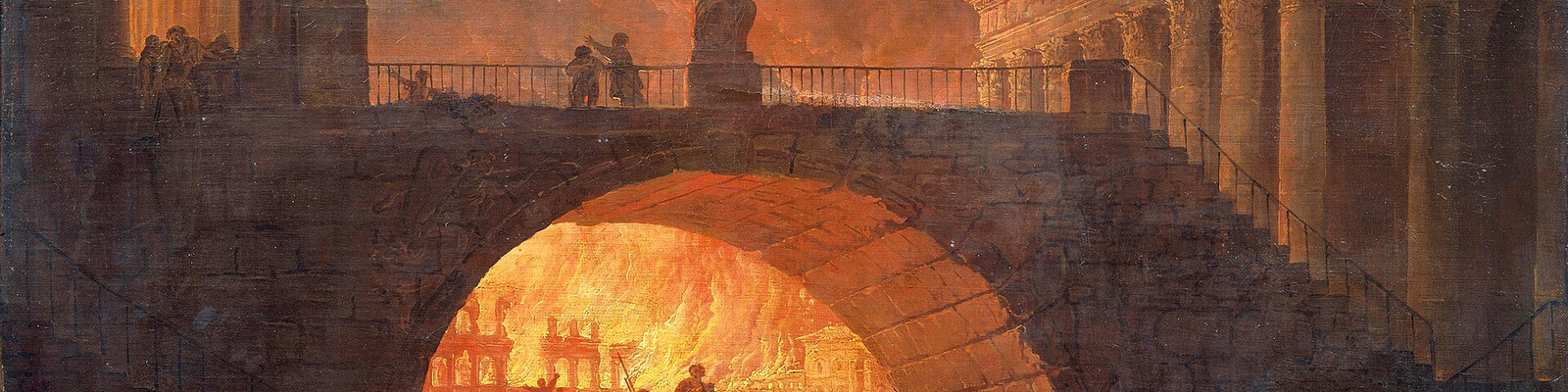
Empires rarely fall with a single blow. More often, they collapse inward, hollowed out by corruption, cruelty, and the slow abandonment of the ideals that once sustained them. The Latin phrase Imperia corrupta cadunt — corrupt empires fall — is not prophecy. It is history, repeated often enough that it should no longer surprise us.
This week, American composer Jeffrey A. Young gave that historical truth a musical voice in a new work titled Imperia Corrupta Cadunt. It is not a retrospective lament, nor a safely distanced reflection on the past. It is a protest composed in real time — a response to events unfolding now, on American streets, carried out by American authorities, in the name of American power.PlayJeffrey A. Young, Imperia Corrupta Cadunt (2026)
Young’s impetus was not abstract ideology but witnessed terror: the violent seizure of a civilian by Immigration and Customs Enforcement in Minneapolis, an act designed not merely to detain, but to intimidate. Such actions are meant to remind the population who holds power — and how arbitrarily it may be exercised. This is not the language of democracy. It is the language of authoritarianism, spoken with an American accent.
The danger of moments like this lies not only in what is done, but in how quickly it becomes normalised. The slow corrosion of civic trust. The repurposing of law as spectacle. The transformation of government into a system that serves the few while demanding obedience from the many. History tells us that when a state reaches this point, it does not need foreign enemies to destroy it. It is already undoing itself.
Young’s music makes that argument unmistakably clear through its materials. Patriotic songs and hymns — once symbols of shared purpose — are set in opposition to We Shall Overcome, the anthem of the American Civil Rights movement. This is not nostalgia. It is confrontation. The music asks a devastating question: what happens when the symbols of patriotism no longer stand for liberty, but for control?
Significantly, the work also draws on the primary motive from Karel Husa’s Music for Prague 1968. Husa wrote in response to Soviet tanks rolling into a city that dared to imagine freedom. Young borrows that motive to suggest something far more uncomfortable: that the warning once issued to the world from Prague must now be heard at home. The lineage is deliberate. The implication is chilling.
In times like these, the arts matter precisely because they are not neutral. They cannot be. When institutions fail and language is hollowed out by propaganda, music retains the ability to speak truth without permission. Composers, in particular, have long understood this. When political protest risks censorship, imprisonment, or worse, music offers a way to resist that cannot easily be silenced. It bypasses rhetoric and goes straight to conscience.
History is full of such examples: Shostakovich writing under Stalin, Husa responding to occupation, Black American composers giving voice to dignity in the face of systemic violence. Today’s composers face a similar choice. Silence may feel safer, but it carries its own cost. To say nothing is to accept the erosion of the values that made artistic freedom possible in the first place.
It is no accident that many artists have begun to withdraw from state-sponsored cultural institutions when those institutions are seen to legitimise power without accountability. Recent refusals by prominent musicians to perform at the Kennedy Center are not acts of petulance; they are acts of conscience. They represent a refusal to allow art to be used as a decorative façade for policies that betray the principles the arts exist to defend.
Young’s Imperia Corrupta Cadunt belongs squarely in this tradition. It does not ask for applause, it asks for recognition. It insists that Americans confront what is being done in their name — and what is being lost when fear replaces empathy, and power replaces justice.
Corrupt empires fall not because they are challenged from without, but because they rot from within. Music cannot stop that process on its own. But it can bear witness. It can warn. And, if we are willing to listen, it can remind us of who we were meant to be — before corruption taught us to look away.
The question, as always, is not whether the music speaks clearly enough.
It is whether we are still willing to hear it.