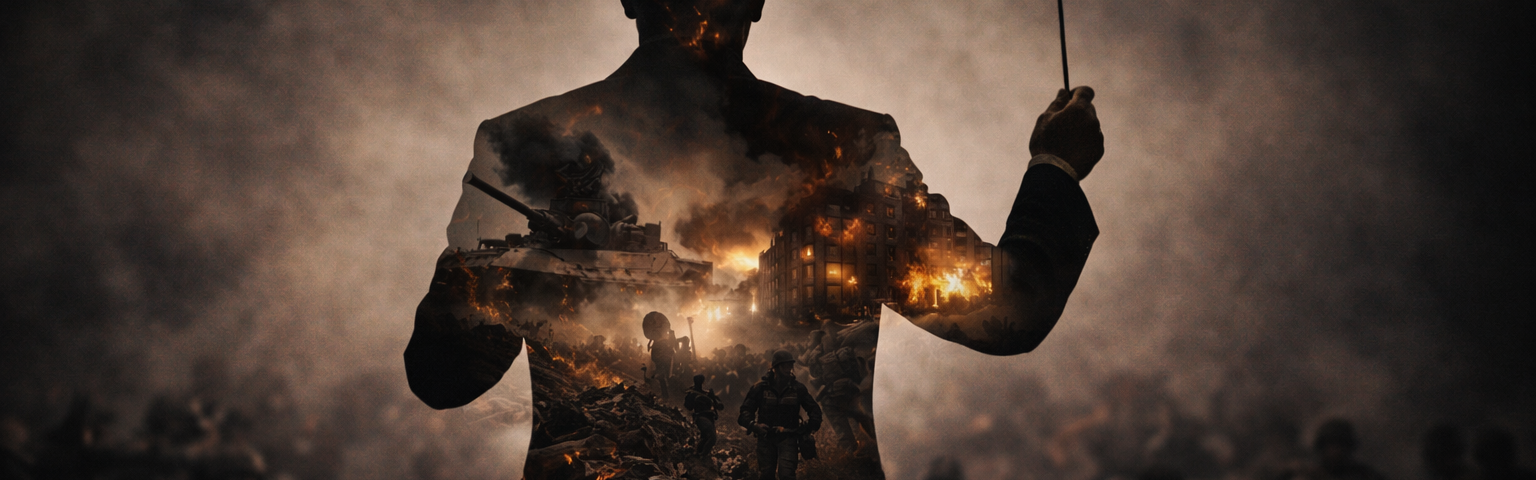
Every conductor understands that programming is an act of choice. What we place on the stand, what we ask musicians to rehearse, and what we present to the public are never accidental decisions. And yet, we often cling to the comforting fiction that repertoire is somehow neutral — that a conductor can simply “let the music speak” without responsibility for what that music says, or why it is being heard at all.
History suggests otherwise.
One of the most uncomfortable examples is Wilhelm Furtwängler, who continued conducting in Berlin throughout the Third Reich. He was not a Nazi Party member, and he claimed that by remaining he was preserving the moral and cultural core of German music against barbarism. Some argue that he protected musicians; others argue that his presence legitimised a regime that was committing unspeakable crimes. The debate remains unresolved — and perhaps it always should.
What matters is not whether Furtwängler was “right” or “wrong,” but what his case reveals: a conductor’s decisions are never apolitical, even when they are framed as purely artistic.
Today, conductors around the world face far less extreme pressures, but the mechanism is familiar. Programming music that is critical of the state — or even music that is merely uncomfortable — can invite repercussions: withdrawn funding, institutional pressure, lost opportunities, damaged reputations. Increasingly, it also means being publicly attacked online — misrepresented, dogpiled, and “beaten up” on social media by people who may never have opened the score, but are quick to pass judgment. More often than not, no one issues an explicit threat. The message is conveyed quietly, politely, and effectively: perhaps this isn’t the right time.
And so many conductors choose safety. They avoid protest works. They relegate politically charged music to the past, where it can be admired without consequence. They convince themselves that neutrality is professionalism.
I know something — on a vastly smaller and safer scale — about the cost of making an unpopular programming choice.
For many years as a school band conductor, I programmed what some would dismissively call “old” music: transcriptions of Bach, Mozart, Beethoven — many of the popular classics. I believed — and still believe — that young musicians deserved direct contact with the core repertoire of Western art music, even when that repertoire did not originate within the wind band tradition. This was not an act of provocation. It was a conviction about musical education and depth.
The response was not tanks or censorship, but it was real nonetheless. I was criticised, marginalised, and quietly judged. I was told — explicitly and implicitly — that I was not a true supporter of band music, not sufficiently loyal to contemporary composers, not aligned with the prevailing orthodoxy. Opportunities narrowed. Professional goodwill cooled. I paid a price for that choice.
I do not recount this to dramatise my experience, but to make a simple point: even modest programming decisions can carry social and professional consequences. Conductors know this instinctively. Which is precisely why the temptation to avoid risk grows stronger as the stakes rise.
Yet this is exactly why the present moment demands courage from conductors.
Composers are once again writing protest music — not about distant history, but about events unfolding now, in their own countries, against their own governments. When an American composer such as Jeffrey A. Young writes a work like Imperia Corrupta Cadunt, the moral burden does not end with the act of composition. The music has done its part. It has spoken clearly.
The question then passes — unavoidably — to conductors.
A protest score left unperformed is politically harmless. It threatens no one. It changes nothing. Only when a conductor chooses to programme it, to rehearse it, to stand before musicians and audiences and insist this will be heard, does the music become what it was meant to be. At that moment, the conductor is no longer a neutral intermediary. They are an active participant.
To claim neutrality in such moments is not to stand above politics; it is to defer to the status quo. History does not judge only regimes and leaders. It also judges institutions — and the artists who sustained them through silence, caution, or compliance.
Conductors do not need to be heroes. They do not need to seek martyrdom. But they must recognise the power they hold. Every program is a statement — and every omission is one as well.
The music of protest has already been written.
What remains to be seen is who is willing to conduct it — and who, years from now, will have to explain why they chose not to.