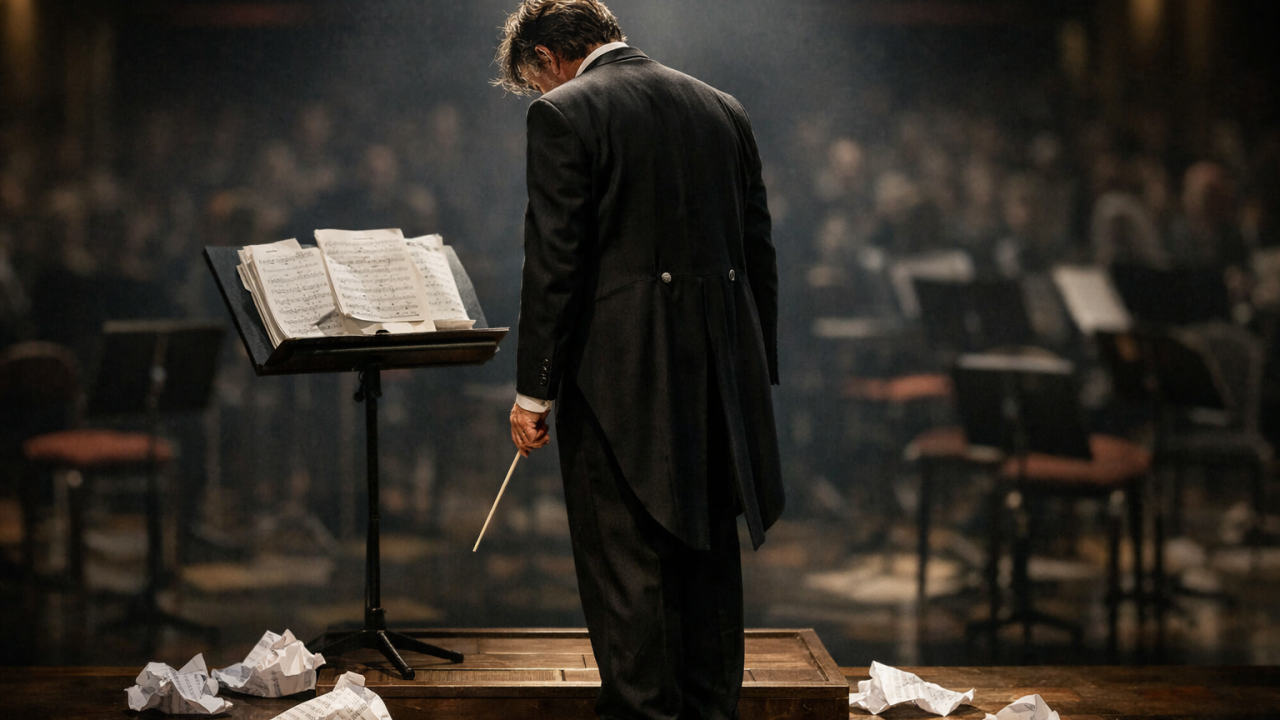
I consider myself a failed conductor.
This is not false modesty, nor a theatrical cry for reassurance. It is simply the most economical way I know to describe a career spent pursuing a sound that never quite materialised. Not once. Not fully. Not even on a particularly good night when the stars aligned and the horns behaved themselves.
The ideal sound existed –– vividly, stubbornly –– in my head. The real sound arrived through the air like a compromise brokered by a committee.
For a long time I assumed this was a personal deficiency. Later I learned that even the great Carlos Kleiber suffered from something similar. He conducted rarely, cancelled often, and was haunted by the gap between what he imagined and what orchestras would actually produce. In a more medicalised age he might have been labelled anxious, avoidant, perfectionistic –– or all three. I am not comparing myself to Kleiber’s genius, only recognising the signs of the struggle. Kleiber had the luxury of walking away. Most of us don’t have that luxury. We conduct whoever turns up on Tuesday evening.
Instrumentation: the first betrayal
The score is mercilessly specific. It asks for three cornets and two trumpets. What you have is five trumpet players, none of whom owns a cornet, all of whom assure you that “it’s basically the same thing.”
It is NOT basically the same thing.
Cornets blend; trumpets declare. Cornets cushion harmony; trumpets sharpen it. Replace one with the other and the entire sonic architecture tilts. But instruments cost money, and musicians understandably prefer not to purchase specialist equipment for the sake of the whim of a single conductor. So the five trumpets play the cornet parts, the texture brightens beyond recognition, and you are left conducting a piece that resembles the original in the way a photocopy resembles a painting.
Is this description melodramatic? Yes. To everyone except me!
Missing instruments are another routine heartbreak. The contrabass clarinet part sits there in the score anchoring the entire wind section, and in the room there is nothing –– just empty air where the foundation should be. You can reassign the line to tuba or bassoon or whatever creature happens to be available, but the colour changes, the weight shifts, and you spend too much time coming up with a solution that you already know is never going to satisfy you.
No one in the audience knows this. They hear “a band.” You hear compromise.
Training: the second betrayal
Even when the instrumentation is technically correct, the style may not be. Many excellent musicians have been raised on twentieth-century band literature –– brilliant, complex, rhythmically intricate, emotionally ambiguous at best, destitute at worst. Ask them to play nineteenth-century repertoire and they confront a different universe: transparent textures, vocal phrasing, unapologetic sentiment. The notes are not necessarily harder, but the language is unfamiliar.
You explain that the line should sing, that the accompaniment should breathe, that the articulation should feel like speech rather than machinery. You end up proscribing every phrase, every beat, every nuance. It is exhausting and extremely ineffective. The musicians nod politely but they don’t really understand what you are trying to say.
Some rehearsals you get to the point where you literally have nothing left to say. You’ve used every weapon in your conducting arsenal and still the music doesn’t match the ideal in your head. This is not laziness on the part of the musicians. It is cultural conditioning. Musicians perform what they have been taught to value. If no one has ever demonstrated how this earlier repertoire lives, it remains a museum object –– technically executed, emotionally inert.
Meanwhile, in your head, the music is glowing with warmth and inevitability, sounding nothing like what emerges from the instruments in front of you.
The tyranny of practicalities
Rehearsals take place after school, after work, after long days during which people have already used up most of their attention and goodwill. Someone is late because of traffic. Someone else has an exam tomorrow. A section leader is absent due to illness. You adjust, re-plan, skip passages, simplify objectives. By the time everyone is present and focused, half the rehearsal is gone.
Energy is a finite resource. Conductors expend it continuously –– listening, diagnosing, encouraging, demonstrating, recalibrating. Unlike players, who can occasionally rest, the conductor is “on” for the entire session.
Over months and years, this energy expenditure (for a nonequivalent return) accumulates into a kind of fatigue that is not dramatic enough to be noticed but deep enough to dull the edge of ambition.
At some point you realise you are no longer pushing toward the ideal; you are managing the achievable.
Knowledge as a burden
Early in my career, ignorance was strangely liberating. If the band sounded reasonably good, I was satisfied. As my knowledge deepened –– historically, aesthetically, technically –– my dissatisfaction grew in direct proportion. I began to hear not just wrong notes or balance issues, but lost colours, misunderstood phrasing, entire stylistic worlds missing from the performance.
Research and score study is dangerous in this way. Once you know what something is supposed to sound like, you cannot unknow it. The score stops being a set of instructions and becomes a promise –– one you are rarely able to fulfil.
Music is a language for communicating feelings. A technically correct but emotionally blank performance is not merely suboptimal; it is a failure of communication. The stakes become existential rather than decorative.
And yet the tools available to you –– rehearsal time, instrumentation, institutional constraints, human variability–– remain stubbornly ordinary.
The slow drain
Frustration is energising at first. It drives you to study harder, rehearse more intensely, programme more ambitiously. But frustration without resolution eventually becomes exhaustion. The effort required to close the gap between ideal and reality exceeds the energy you have left to give.
This is not a sudden collapse but a gradual realisation. You notice yourself choosing safer repertoire, moderating expectations, accepting compromises you once would have fought. You tell yourself you are being pragmatic. Part of you knows you are giving up.
I did not have a dramatic breaking point. I simply reached a stage where I understood, with uncomfortable clarity, that I was never going to hear the sound in my head produced by any band I was likely to conduct. Not because the musicians were inadequate, but because my own abilities were too few and the conditions required were too rare, too fragile, and too expensive in every sense of the word.
Failure without disqualification
To call oneself a failed conductor is not to deny the value of the work done. My bands improved, my students learned, my audiences applauded. On paper, the career was respectable. But the internal measure was never applause or institutional approval; it was whether the music sounded as it ought to sound.
By that measure, I failed.
Yet failure in execution does not necessarily invalidate perception. A critic who cannot compose may still recognise a masterpiece. A coach who cannot perform at Olympic level may still understand biomechanics. Likewise, a conductor who never realised the ideal may still see clearly why the ideal is so difficult to achieve –– and what structural changes might bring others closer.
In fact, those who succeed easily sometimes lack this perspective. When conditions happen to align in their favour, success can appear natural, inevitable, even deserved. Those who struggle become acutely aware of every variable: training systems, repertoire traditions, funding priorities, equipment, institutional culture, audience expectations. Failure becomes a form of education.
Why speak at all?
There is an unspoken rule in many fields that only the visibly successful are entitled to opinions. By that standard, one should wait for international acclaim before discussing music education, repertoire choices, or aesthetic priorities. Unfortunately, by the time someone achieves that level of success, they are often too busy to engage in public reflection –– or too invested in the existing system to question it.
I speak not because I conquered the mountain, but because I spent years climbing it and can describe where the paths collapse, where the weather turns, and where the maps are misleading. The view from halfway up is still a view.
If anything, failure sharpens urgency. When you know how rarely everything aligns, you become less interested in superficial improvements and more interested in structural ones –– the kind that might allow future conductors to achieve what you could not.
The unfinished argument
Perhaps the real tragedy is not that the ideal sound remained unrealised, but that so few systems are designed to pursue it seriously. Music education often prioritises participation over depth, efficiency over expression, novelty over continuity. Under such conditions, even the most dedicated conductor is fighting upstream.
To acknowledge this is not to indulge in bitterness but to insist that the gap between imagination and reality is not purely personal. It is cultural, institutional, and historical.
And culture can change.
A different kind of success
In the end, I may never conduct the performance I hear in my head. But if articulating the obstacles helps others move closer to their own ideals –– if a student acquires the right instrument, if a programme embraces repertoire more deeply, if a teacher realises that emotion rather than accuracy is the true objective –– then the effort has not been wasted.
Failure, after all, is not silence.
I am a failed conductor. But I am not a mute one.