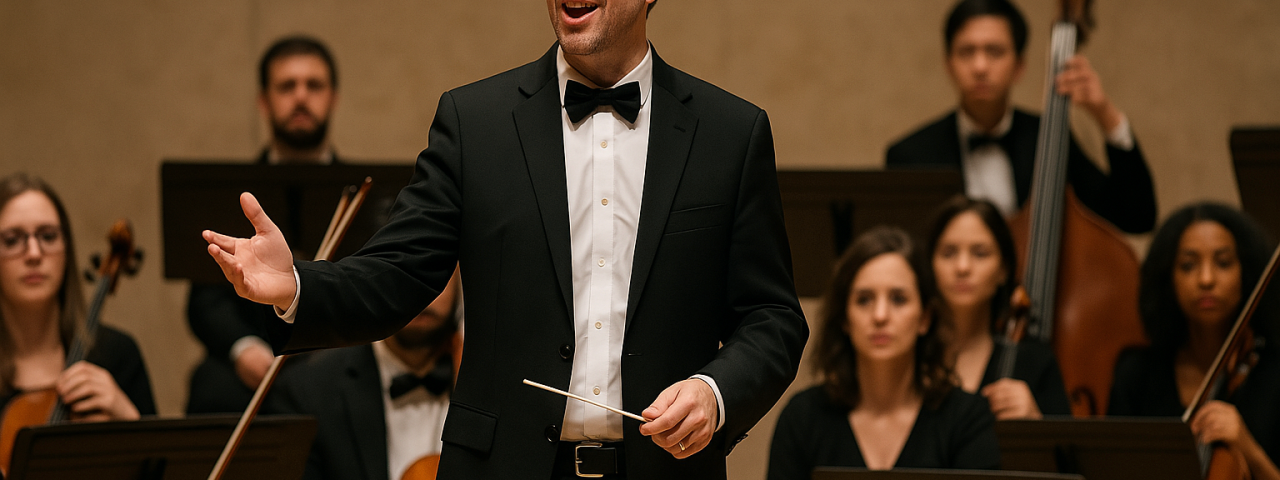
In the majority of community and school concerts, conductors are speaking to their audiences before, during, and after a performance. While this may seem like a friendly and engaging way to connect with the audience, it raises interesting questions about the role of the conductor, the relationship between music and audience, and the potential impact on the listening experience.
The Role of Music: Communication Beyond Words
Music has long been recognised as a universal language—a medium that transcends words, cultures, and barriers. As listeners, we don’t analyse music in the same way we do written text or spoken language. Instead, we experience it on an emotional level, processed through the right hemisphere of our brains. This hemisphere is attuned to the experiential aspects of music, which is why we feel moved by a composition without needing to understand its technical components.
The challenge arises when conductors interrupt this emotional experience with spoken words, appealing to the rational, left hemisphere of the brain. This creates a kind of “mental ping-pong”—alternating between the logical and emotional centres of the brain—which can detract from the overall experience.
The Disruption of the Musical Flow
The act of speaking before a performance or between pieces can disrupt the flow of the concert. Music, in its purest form, is an immersive experience.
When a conductor takes time to explain a composition or describe its structure, the audience may feel as though they are expected to understand it intellectually rather than emotionally.
This not only confuses the listener but also risks removing them from the moment, replacing emotional immersion with analysis.
For example, consider a performance of Schoenberg’s Theme and Variations for band. When a conductor takes the time to point out the theme before the performance, the audience is now focused on identifying this theme throughout the variations. While this is an intellectually interesting exercise, it undermines the composer’s intent—to convey the profound emotional depth of the work. Instead of experiencing the piece, the audience is caught up in trying to follow technical details that may not align with the music’s emotional message.
The Psychology of Listening
The key issue here lies in how we process music. Our brains are naturally wired to understand music emotionally and experientially. This is why we don’t need to know about musical theory to appreciate a symphony; the music speaks to us directly. However, when conductors introduce analysis or theory, they risk making the audience feel inadequate—implying that understanding the music requires knowledge of its construction.
What’s more, there’s a psychological aspect to consider. When a conductor begins a concert by welcoming the audience or explaining the program, they inadvertently shift the audience’s focus from the music to the speaker. This shift in focus can be jarring and takes time for the audience to recalibrate. The audience must now “switch gears,” from a rational listening mode to an emotional one. This transition is not always smooth and can detract from the overall experience.
Does Talking to the Audience Actually Help?
Some conductors may feel compelled to speak to the audience because they believe it will help listeners understand the music better. However, this belief is based on a misunderstanding of how music communicates. Music is not about words or explanations—it’s about experience. No matter how much information is shared beforehand, the music’s emotional impact cannot be fully conveyed through verbal description.
Moreover, research on the brain’s bicameral nature—the way our two hemispheres process information differently—supports this idea. The right hemisphere, responsible for understanding music, operates outside the realm of language. When a conductor speaks about the music, the left hemisphere becomes engaged, creating a disconnect between the brain’s analytical and experiential functions.
The Importance of Programming
The best way for a conductor to “educate” the audience or create an engaging performance is not through talking, but through thoughtful programming. The music itself should speak for the importance of music.
A carefully curated program can guide the audience on an emotional journey without the need for explanations.
The emotional resonance of each piece will engage the audience in ways words cannot.
Conclusion: Trust the Music
Ultimately, the music should be the star of the show. The audience has the ability to understand and appreciate the nuances of a performance without the need for verbal intervention. Conductors should trust in the audience’s ability to connect with the music on an emotional level. If the music is compelling and the performance is strong, the audience will respond—no words necessary.