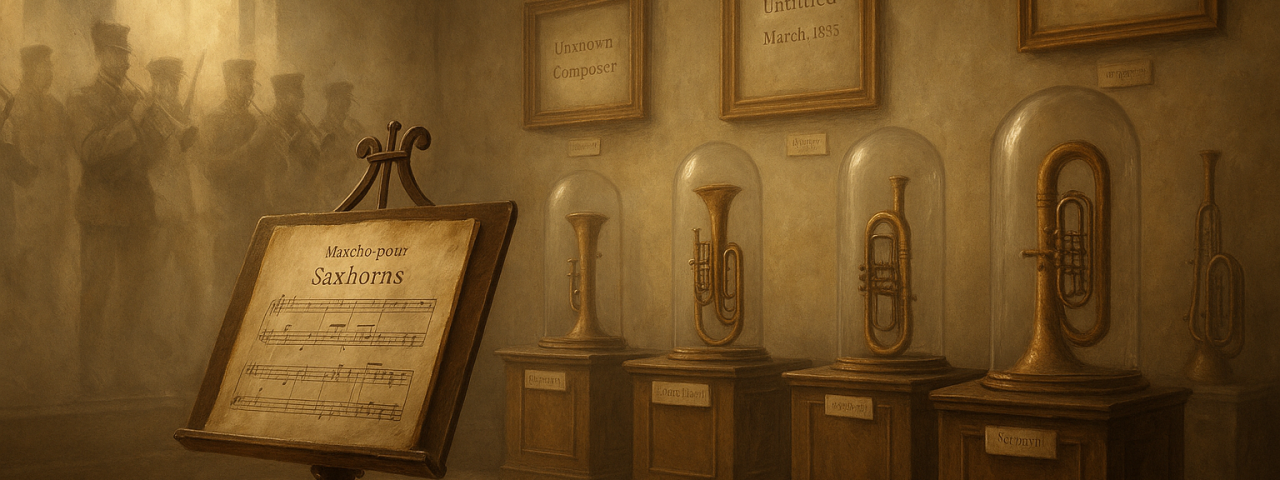
In the visual arts, the past is everywhere. Even lesser-known painters from past centuries are preserved in galleries, catalogued, and studied. Minor works hang next to masterpieces, contextualised by curators and historians who help us understand what they meant in their own time.
In music, by contrast, only the most famous names survive. The rest—thousands upon thousands of composers and compositions—are rarely even footnoted. And nowhere is this historical amnesia more pronounced than in the world of 19th-century band music.
The Problem Is Structural
In his 1902 treatise Zur Geschichte der Instrumental-Musik, Hermann Eichborn lamented this phenomenon:
“Only when we have remedied the disgraceful inequality shown by music in comparison to the other arts—whereby nearly all that was produced in past centuries, save for a few geniuses, is summarily condemned as old rubbish… only then… shall we be in a position to form a reasonable and reliable standard by which to judge the productions of the present, and thereby to chart the surest course for future progress.”
This is not about nostalgia. It is about context. Without an understanding of the many voices that shaped the musical landscape of a given time—not just the canonical ones—we cannot properly understand where we came from, nor where we’re going.
Why Band Music Is Especially Vulnerable
Band music suffered a unique fate. In the 19th century, the instrumentation of wind bands was in constant flux. Unlike the orchestra, which had largely stabilised by the mid-1800s, bands remained experimental by nature. New instruments—ophicleides, saxhorns, valve trombones—were continually being invented, modified, or falling out of use.
As a result:
- Even when scores were published—and many thousands were [libraries in France, Germany, Belgium, and Italy still contain thousands of printed 19th-century military and civic band scores, many of which are listed in the catalogues of the Bibliothèque nationale de France and Staatsbibliothek zu Berlin]—they were quickly rendered obsolete, written for ensembles that no longer existed in the same form.
- Performing such music even a decade later often required substantial adaptation, transposition, or re-orchestration—tasks that very few musicians had the time, training, or incentive to undertake.
- Without continual revision and performance, the music faded from use, and so too did the names of the composers who wrote it.
The issue, then, was not the scarcity of music—but the instability of the medium that carried it.
The Scale of the Loss
By the late 19th century, there were estimated to be more than 10,000 community bands in the United States alone. In Britain, the brass band movement reached every mill town and mining village. In France, the Orphéon movement, originally rooted in amateur choirs, had by the mid-century become closely tied to civic wind and brass bands. A government-sponsored survey conducted in the 1860s recorded thousands of wind and brass ensembles not only in France, but across the world.
Each of these bands maintained its own repertoire—marches, potpourris, fanfares, religious settings, operatic transcriptions and yes, original aesthetic works—tailored to its local audience and ensemble. Much of it was printed, catalogued, and performed competitively. And yet today, very little of this music is known, let alone programmed.
The infrastructure that supported these bands—municipal councils, military regiments, factory owners, regional competitions, Sunday promenade concerts—has either vanished or changed beyond recognition. And with it, the music disappeared.
What We Lose When We Forget
Rediscovering this music is not a sentimental exercise. It is an act of scholarship. It is a cultural imperative.
When we fail to preserve or explore the work of “ordinary” composers, we create a false impression of history—one where only genius existed, and everything else was silence. But the musical life of the 19th century was teeming with activity. The very idea of public music—played in open-air kiosks, barracks, village greens, or national exhibitions—was formative in shaping listening habits, civic identities, and local pride.
We are not just recovering forgotten sounds. We are restoring the missing texture of history.
Towards a New Standard
Eichborn’s point is as urgent today as it was in 1902: if we want to evaluate the music of our own time intelligently, we need a more complete understanding of the past. Not just the masterpieces—but the middle ground. The journeymen. The local heroes. The innovators who never caught on.
Band music is one of the last great frontiers of musicological recovery. It is fragmented, scattered, and often difficult to decode—but it is there. And it is waiting.