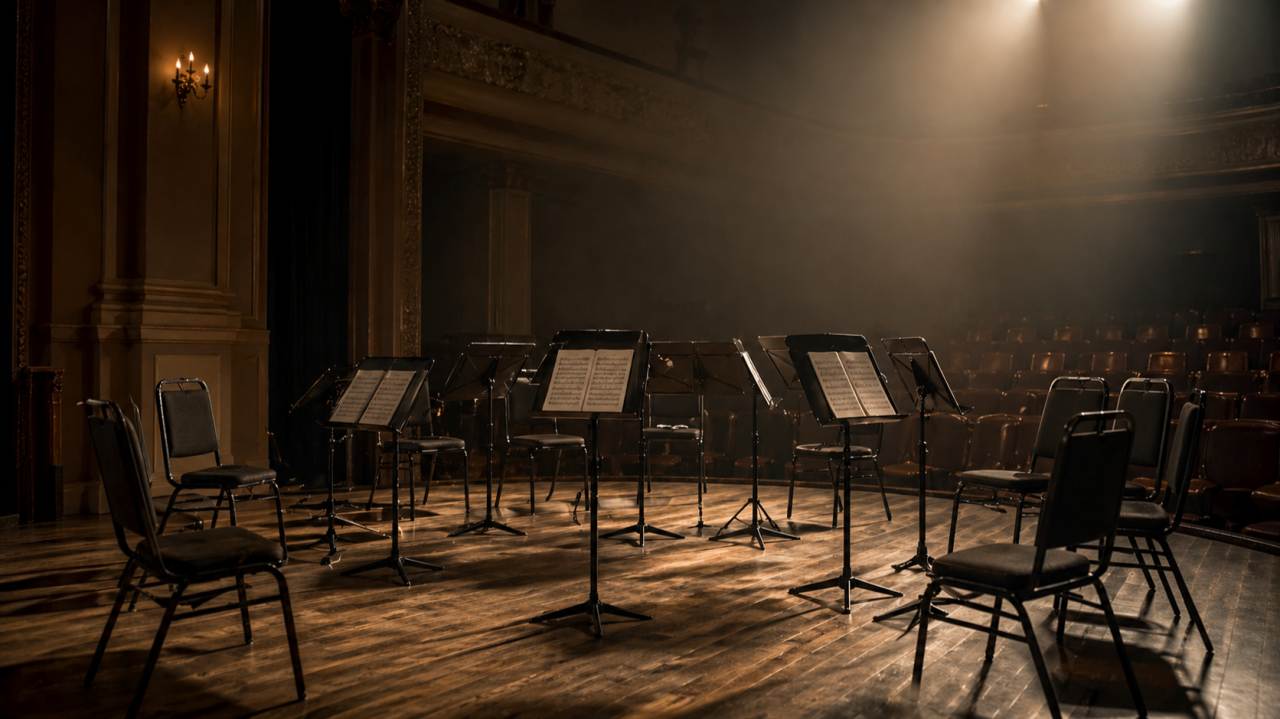
I’m thinking of staging a concert. Not a grand symphony orchestra. Not a full concert band. Just twelve players in a small ensemble, performing beautiful, neglected music that deserves to be heard.
On paper, this sounds modest. In practice, it’s beginning to feel impossible.
I refuse to ask musicians — friends and colleagues — to play for free. In the professional world, musicians should be paid for the rehearsal and the performance. Let us assume just one rehearsal (already cutting things dangerously fine) and one concert.
I think I might persuade musicians to do this for $250 each. Twelve players: $3,000. But here is the first uncomfortable truth: that $250 is only half of what they ought to be paid. They should be getting that for both the rehearsal AND the concert — $500. Even my “realistic” budget begins with musicians accepting less than they deserve.
And we have not yet hired a venue.
A concert needs somewhere people can actually reach: parking, public transport, shelter from weather, and a room with enough dignity for music to matter. A suitable inner-city venue I found quoted $4,800. This was the base price without any addons.
Now we are at $7,800—
and that is before a poster is printed, before catering is considered, before a single ticket is sold. Before I have spent dozens — perhaps hundreds — of unpaid hours editing parts, copying music, rehearsing players, promoting the event, handling logistics, and carrying all the risk.
People sometimes ask why tickets cost what they do. Simple maths gives the answer.
At $30 per ticket, one hundred tickets merely pays the musicians — and only at their “discounted” rate. It does not pay for the venue. It does not pay for me. And one hundred tickets are not guaranteed.
If somehow a venue could be had for free, the concert might scrape into possibility. But only because the organiser donates their labour. And that, as most of us realise, is the hidden economy of artistic life: concerts often happen only because someone subsidises them with unpaid devotion.
I would gladly perform for love.
But I would never assume that everyone else would.
Because behind even the smallest concert lies invisible labour: finding repertoire, typesetting scores, preparing parts, persuading musicians, managing logistics, selling tickets, taking the financial risk.
The audience sees ninety minutes. The organiser works for six months. And so I wonder whether small-scale live music is not merely difficult, but structurally broken. Not because audiences do not care. Not because musicians lack commitment. But because the maths so often defeats the art.
We romanticise the chamber concert as intimate and achievable. Yet for independent musicians, it is almost impossible to stage one without subsidy, philanthropy, institutional support — or self-sacrifice.
And still — the desire persists.
Because somewhere in me remains the absurd conviction that twelve players in a room can create something worth all this trouble.
Perhaps every concert is a small miracle. Perhaps the impossibility of staging a concert is precisely what makes those that do happen so precious. But some days, looking at the numbers, it feels less like miracle and more like madness.
And I confess: sometimes I think attempting even a small concert is impossible.
Craig Dabelstein. “The impossibility of staging a concert: why even the smallest concert demands impossible sacrifice.” craigdabelstein.com, 27 April 2026, https://craigdabelstein.com/the-impossibility-of-staging-a-concert/.