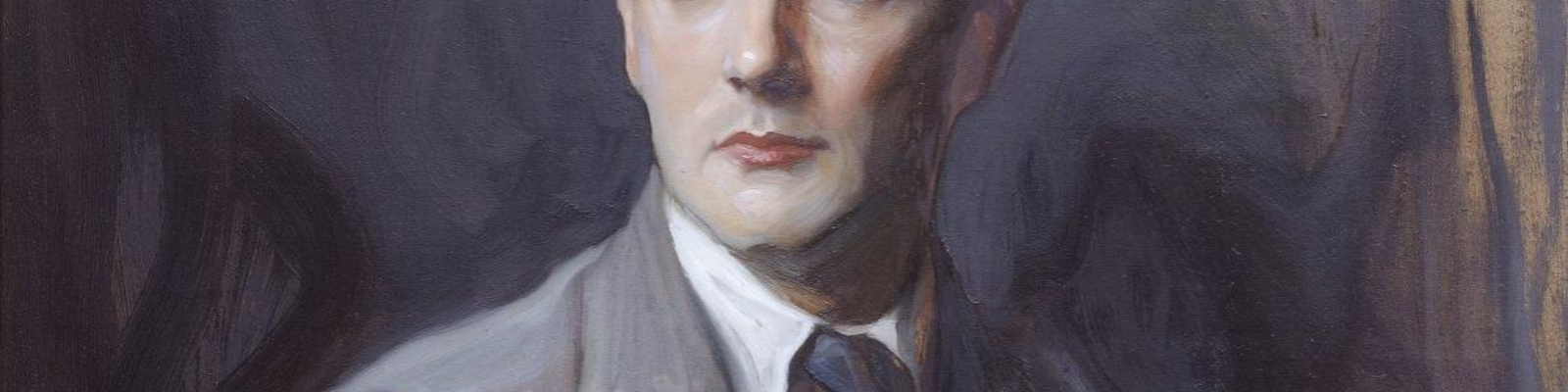
Donald Francis Tovey for the Twenty-First Century, part 1
Walk into almost any conservatorium or university music department today and you’ll hear plenty about harmony, counterpoint, analysis, performance practice, psychology, acoustics, history, and cultural studies. Students learn how music is constructed, where it came from, and how it has been interpreted over the centuries.
But there is a surprisingly simple question that is asked much less often.
What is music?
Not sound. Not notation. Not harmony. Not style.
What is the thing itself?
Nearly a century ago, the Scottish musician, composer, pianist, and scholar Sir Donald Francis Tovey attempted to answer that question in a remarkable series of public lectures. Delivered in Glasgow in 1936 and Liverpool in 1938, they were later collected under the informal title A Musician Talks. Despite their conversational origin, these lectures amount to nothing less than a philosophy of musical art.
Unfortunately, they have become difficult books to read.
This is no fault of Tovey. He belonged to an age in which educated audiences were expected to recognise references to Aristotle, Shakespeare, Newton, Goethe, Bach, Wagner, mathematics, architecture, and Greek tragedy without explanation. His sentences are long, his arguments unfold gradually, and he delights in pursuing an idea from several different directions before finally revealing its destination. Reading Tovey often feels less like reading a textbook than listening to a brilliant man think aloud.
That richness is precisely why these lectures deserve to be read today. Yet it is also why many modern readers never make it very far.
This series is an attempt to bridge that gap.
The purpose is not to simplify Tovey’s ideas into slogans, nor to replace his words with my own. Rather, it is to unpack each lecture in plain English, preserving the depth of his thought while making its central arguments easier to follow. My hope is that readers will feel encouraged not only to understand Tovey, but eventually to return to the original lectures themselves.
As I worked through A Musician Talks, I gradually realised that the ten lectures are not really about ten different subjects. At first glance they appear to discuss harmony, opera, inspiration, musical form, tonality, criticism, and movement. In reality, they are all chapters in a single argument.
Tovey returns again and again to a handful of profound ideas.
He insists that music is an art rather than a science. He reminds us that the score is not the music; it is merely the means by which music is preserved. He argues that theory should explain our listening, not replace it. Musical form is not a mould into which composers pour ideas, but something that grows organically from the ideas themselves. Great music unfolds in memory, not on paper. Technique exists to serve artistic expression. Analysis should illuminate our experience of music, never substitute for it. And the greatest works remain inexhaustible because they continually reveal more than they explicitly say.
Those themes will appear again and again throughout this series.
What surprised me most was how modern Tovey sounds. His lectures were delivered almost ninety years ago, yet many of the assumptions he challenges remain common today. We still confuse technical mastery with artistic understanding. We still analyse scores as though analysis were the same thing as listening. We still imagine that historical research can explain why a masterpiece is great. We still speak about music as though it were an object rather than an experience.
Tovey asks us to think differently.
For him, music is something that lives only when it is heard, remembered, imagined, and performed. Its meaning cannot be reduced to rules, diagrams, or historical facts, however valuable those things may be. Music is an event, unfolding through time, continually renewed in the minds of listeners. Again and again he reminds us that the score is not the artwork. The artwork exists only in living musical experience.
That is why I believe Tovey still matters. He does not teach us merely how to analyse music. He teaches us how to listen.